01 · Reward
Anticipation has a soundtrack.
Music-related pleasure can involve reward circuitry. Research distinguishes anticipation from peak emotional response; that does not mean every replay is a dopamine event.
Salimpoor et al. (2011) ↗A field note from the headphone dimension
An artist. A listener. A remarkable number of replays. And a bigger question: what does music actually do for the human mind?
See the receipt ↓Explore the research ↓Exhibit 001 · August listening recap
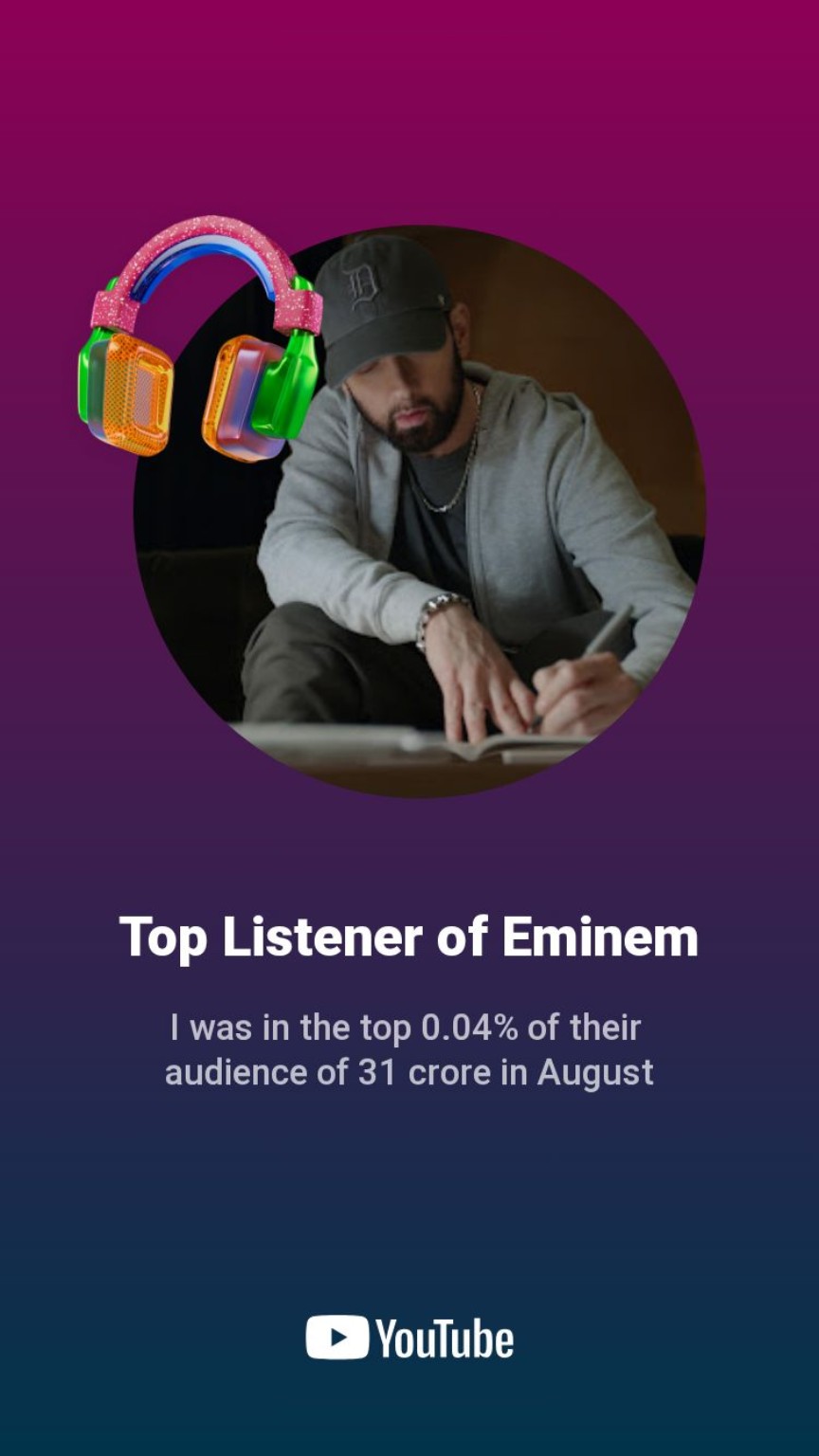
This is an authentic reproduction of the supplied YouTube recap screenshot. The figure is a platform-reported listening statistic, not an independently verified ranking. It refers to August, not lifetime listening.
The uploaded file was named “0.03% of Professor Slim Shady.jpg”, but the image itself clearly says 0.04%. We use the number shown in the evidence.
The literature · Not pop-neuroscience
01 · Reward
Music-related pleasure can involve reward circuitry. Research distinguishes anticipation from peak emotional response; that does not mean every replay is a dopamine event.
Salimpoor et al. (2011) ↗02 · Autobiography
Familiar music can evoke autobiographical memories. A track may be linked to a period of life, a place or a person—not just its lyrics.
Janata (2009) ↗03 · Regulation
People use music for different emotional goals: maintaining, shifting, expressing or understanding a mood. Outcomes vary with context and listener.
Saarikallio & Erkkilä (2007) ↗04 · Expectation
Musical expectation helps explain the pleasure of patterns, deviations and returns. This is a useful lens for rap cadence, without reducing artistry to a formula.
Cheung et al. (2019) ↗05 · Identity
Music preferences can participate in social identity and self-expression. Liking an artist is not equivalent to endorsing everything their persona says.
Rentfrow & Gosling (2003) ↗Epistemic note: These studies support broad mechanisms in music experience. They do not establish why this particular listener played Eminem so often, nor prove therapeutic benefit for any individual.
Interactive exhibit · Original text, not copyrighted lyrics
Rap is not merely words on a beat. Listen for stress, timing, internal rhymes, assonance and multisyllabic patterns. Here is a tiny original demonstration; the colours group approximate vowel echoes, not perfect phonetic rhymes.
Pattern A: mind / find / time. Pattern B: motion / ocean / devotion. Say it aloud and move the stress around.
Try this with a favourite track: first listen for meaning, then listen only for rhythm. Notice how much information changes when your attention changes.
The human behind the headphones
Sometimes a voice, a rhythm or a particular kind of humour becomes part of the soundtrack to our lives. The meaning is personal; the mechanisms are worth investigating. This site celebrates close listening, artistic craft and intellectual curiosity—not celebrity worship, clinical claims or a ranking of human worth.
And yes, there is something wonderfully funny about building an entire research exhibit around a YouTube Music badge. The monkey has receipts. 🐒
Explore music ↗Explore rap ↗Return to Sahilverse ↗Email the curator ↗